How Ohio State’s Student Government Learned to Stop Deliberating and Love the Budget
Ohio State’s student government controls $670K but mocks oversight, sidelines dissent, and rewards speed over scrutiny.
On July 23, the Undergraduate Student Government (USG) met to rubber-stamp its interim budget: a $196,000 package funding dozens of student-facing programs.
Nearly every corner of USG leadership was present. Senators were there to vet the bill. Executive directors had written much of it. Justices showed up to discuss changes to their own panel’s rules. On paper, it was one of the rare moments when the General Assembly could exercise real oversight, asserting its authority before the money went out the door.
That’s not what happened.
The Price of Deliberation
Before the Assembly could even get to the budget itself, senators were still untangling procedural knots, like whether someone serving in both the executive and legislative branches could cast a vote during the interim session. It was the kind of boring but necessary work that clears the way for real debate.
But one executive staffer wasn’t willing to wait. Hayden Price, Senior Counselor to the Executives on Initiatives, was the first to speak up, not through formal debate, but in the Zoom chat, where he reduced oversight to a running gag.
Hayden Price – 7:19 PM
Fun fact everyone: Ohio minimum wage is $10.70 per hour. There are 45 people in this meeting. That means that for each minute we waste of 45 people time, we are wasting $10.75 * 45 people / 60 minutes = $8.02. At 19 minutes into this meeting so far, that's been $152.38 so far! Seeing as many of us have received an education that would allow our time to be valued much higher than $10.70 per hour, feel free to redo that calculation with your own number! The numbers are exciting.
Cosigned by: Emma Hart (Co-Director of Sustainability), Lorelai Turner (Senior Director of Issues), Matthew Okocha (Chief Justice of the Judicial Panel)
Hayden Price – 7:45 PM
Holy shit we’re at $346.69. At what point is this meeting costing more than the budget we’re here to get passed?
Cosigned by: Lorelai Turner, Hanniel Diaz Elizarraga (Former Senior Director of Allocations)
Hayden Price – 8:03 PM
Oh my god I could update the math or people could just realize that this is an insane and disrespectful waste of everybody’s time.
Cosigned by: Jessica Asante-Tutu (Now-President), Hanniel Diaz Elizarraga
These were live, on-the-record remarks from USG’s most senior officials, broadcast in real time while the General Assembly tried to do its job. This wasn't just snide humor; it was a mockery of the notion that student government should involve rules, debate, or any friction.
How does a culture like this take hold? How does a deliberative body get taught not to deliberate? To get an answer, you have to follow the money.
A Decade of Growth
Over the past decade, Student Government has steadily claimed a larger share of the Student Activity Fee, a mandatory $40-per-semester charge pooled from every Ohio State student to fund campus life.
The Student Activity Fee brings in roughly $4.6 million each year. That money is divided among a few dominant players: campus-wide entertainment through the Ohio Union Activities Board, competitive funding for student organizations, and direct allocations to the three student governments—USG, the Council of Graduate Students (CGS), and the Inter-Professional Council (IPC).
In theory, each slice gets a say. But in practice, Student Government’s share is the only one that’s meaningfully grown, steadily expanding while the others hold flat.
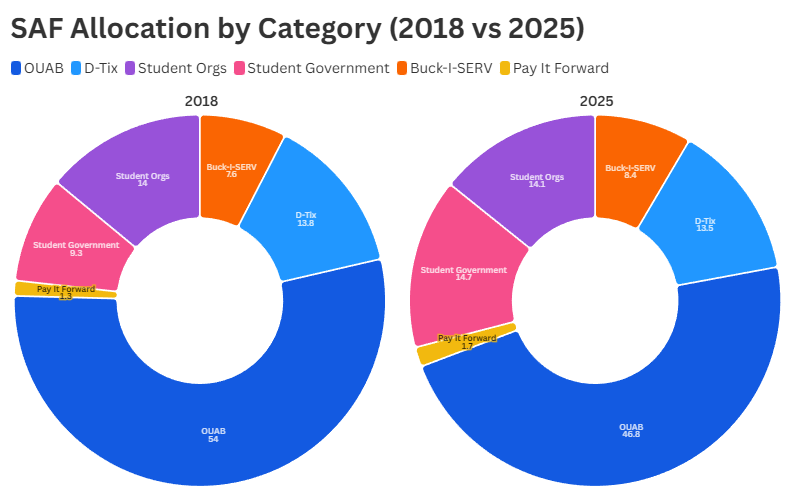
Back in the 2016–2017 academic year, USG received just over $260,000 from the Student Activity Fee. By 2024–2025, that figure had climbed to more than $670,000, more than doubling in under a decade.
Meanwhile, independent orgs operate on fixed budgets, limited guidance, and a revolving door of unpaid volunteers. From 2018 to 2025, their share crawled from 14.00% to 14.12%. Over that same stretch, Student Government’s allocation surged nearly 60%, from 9.26% to 14.70%.
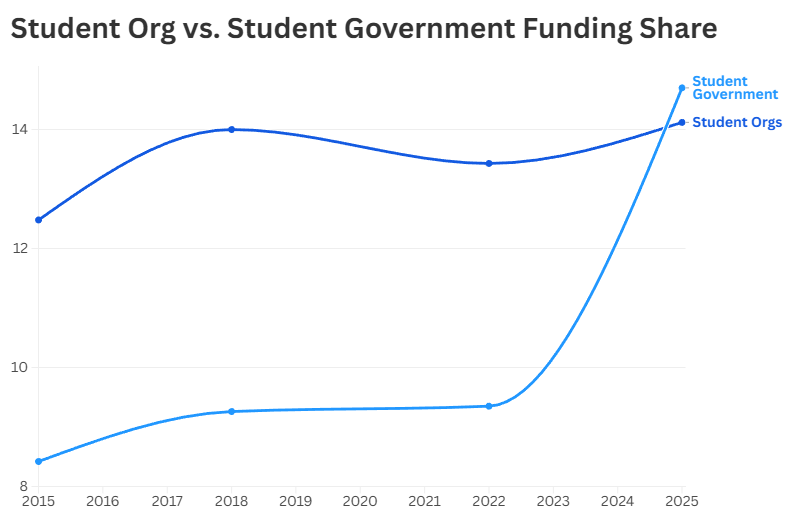
That means three organizations, USG, CGS, and IPC, now collectively receive more funding than the entire rest of Ohio State’s 1,500+ registered student orgs combined.
Put another way: the combined Student Government budget could fund at least 200 independent organizations at the full $3,000 cap, assuming every one of those orgs received the maximum allocation. In reality, most receive far less, meaning the same amount could realistically sustain well over 1,000 more organizations.
This isn’t just a question of growth. It’s a transfer of power, from the student body to a closed ecosystem that controls its own funding with minimal accountability.
Conflict of Interest
That shift has been quietly institutionalized through the Council on Student Affairs (CSA), the student-majority body that approves SAF allocations and shapes the rules that govern them.
In theory, CSA serves as a democratic check on spending. In practice, it’s dominated by insiders, with most student voting seats going to USG members, and the remainder largely filled by CGS and IPC.
Independent student organizations? They’re granted just two seats, and only as Allocations-Only Members, a designation that strips them of any real influence. They can weigh in on the annual budget pie chart, but they have no vote on policy, no role in broader deliberations, and no say in how the system itself is structured.
More than 1,500 student organizations operate under capped budgets, minimal support, and constant leadership turnover, while Student Government maintains control of the process, dominates the seats, and secures the largest share of funding.
Authority in Name Only
This spending gets even murkier when one considers how USG allocates it internally.
On paper, the General Assembly holds the power of the purse. Its constitution explicitly gives it final authority over USG spending. But in practice, that authority is more theoretical than real.
By the time a budget hits the Assembly floor, it’s already been shaped, if not pre-approved, by a gauntlet of executives and administrators.
The Issues and Operations Committees begin by building their ideal funding proposals. Those figures are then passed to the Chief Financial Officer, who works directly with Student Life’s professional staff, university business managers tasked with ensuring the numbers add up and the allocations stay within policy.
Under this structure, the Assembly technically retains the power to shift priorities. But doing so runs headfirst into institutional inertia, administrative constraints, and executive pushback. Line-item cuts are tolerated. Anything more is discouraged by design.
The result is a budget shaped long before it reaches the Assembly floor, not a proposal to weigh, but a product to approve.
Sincerity as Heresy
Which is why, when Senator Jesús Valencia introduced an amendment that challenged the committee’s comfort zone, it didn’t just fail; it was quietly buried.
A Mexican-American student and member of the Justice & Equity (J&E) Committee, a body tasked with supporting initiatives for marginalized students, Valencia had noticed something others had only tiptoed around. In practice, J&E’s programming had become almost exclusively centered on queer events.
So he proposed a fix: a new grant program to support BIPOC-focused events. Not to replace queer programming, but to widen the tent, to ensure the committee’s resources reflected the full scope of its name.
But the amendment stumbled, as it carried a real procedural flaw: it subtracted funding from a Pride event but lacked binding language to establish the new BIPOC grant. Valencia didn’t realize his amendment would functionally trigger a targeted cut. Once informed, he immediately moved to rescind it.
No one brought the idea back. The room had already moved on. Reopening the discussion would’ve meant slowing things down, and no one wanted that.
In USG, if a motion isn’t flawless on the first try, it’s framed as a waste of time. When the executive gallery had already spent the night sneering at deliberation, the warning was loud and clear: slow things down, and risk becoming the punchline.
In a room that claimed to champion equity, a proposal to expand it died not on its merits, but on a technicality.
The Throughput Trap
Because this system isn’t designed for politics. It’s designed for throughput.
CSA doesn’t limit overall spending or require committees to compete for a limited pot. That means budgets can keep growing without any forced tradeoffs. And the General Assembly, the only constitutional check on this growth, has been trained to see its own authority as a nuisance. Better to nod things through than risk becoming the reason a meeting runs long.
In USG, deliberation is treated like delay. Tradeoffs are taboo. And the idea that one marginalized group might be underserved? That’s treated not as a prompt for honest reckoning, but as a threat to institutional peace.
Acknowledging that BIPOC students felt excluded would’ve meant dragging that intersectionality into the open. It would’ve meant admitting that inclusion has limits, and that someone is always making choices about whose identities get prioritized.
Because USG isn’t short on resources. It’s short on anyone willing to play politics: weighing competing needs, defending priorities, and accepting that equity requires saying no to something. In the absence of honest politics, the machine will keep making choices, just not ones anyone is willing to answer for.
Breaking the Cycle
The ability to hit the stop button still belongs to the General Assembly. It’s just been gathering dust for a while.
Each year, it signs off on a budget built by the same officials responsible for carrying it out. Each year, it surrenders a little more to a process that treats scrutiny as sabotage rather than stewardship. And each year, the numbers grow, but the questions don’t.
Senators could demand a real role from the beginning of the budgeting process. Independent orgs could challenge CSA’s makeup, where 1,500 groups share just two seats, while Student Government fills the rest. And USG could create a culture where students like Valencia aren’t sidelined for asking hard questions, but backed for doing what others won’t.
There's $670,000 disappearing into a system where the people who control the money also control the votes that allocate it. Where deliberation is openly mocked. Where good-faith attempts to expand inclusion get buried because they aren't procedurally perfect on the first try.
This isn’t healthy politics. It’s self-sustaining, self-serving, and moving faster with each cycle. Someone in the room needs to hit the emergency stop. Not to break the machine, but to ask if it still does what it was built to do.
Notes On Sourcing
Jesús Valencia was contacted on November 8, 2025, but did not respond to a request for comment. Hayden Price was contacted on July 24, 2025 regarding his comments, and also did not provide a response.
Budget details were obtained from publicly available documents on the Undergraduate Student Government website: usg.osu.edu/resources/finances-funding.
Breakdowns of Student Activity Fee allocations were sourced from the Student Activity Fee FAQ page, maintained by the Office of Student Life: activities.osu.edu/about/student_activity_fee.
Information on the composition and responsibilities of the Council on Student Affairs (CSA) was drawn from the CSA Annual Report for 2024–2025: CSA Annual Report PDF.