The Budget Discrepancy Speaker McCann Wouldn’t Acknowledge
Student government says it spends 7%. The real number is double that.
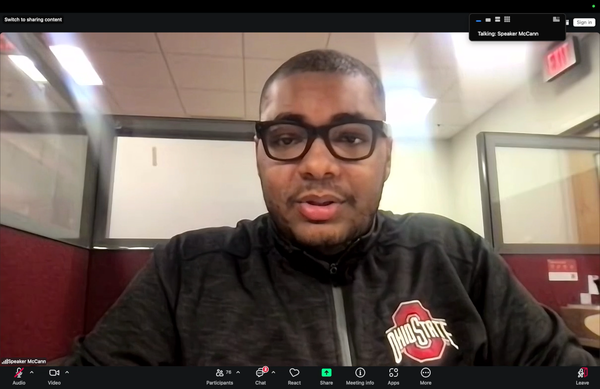
“No it’s not. That’s incorrect, sir.” That was Speaker Terrell McCann’s response during public forum at the November 12 meeting of Ohio State’s Undergraduate Student Government (USG) General Assembly.
I had just stated that Student Government as a whole receives 14.7% of the Student Activity Fee (SAF), citing Student Life’s own public materials, which list USG, CGS, and IPC as collectively receiving that share from the variable portion of the fund.
Technically, McCann was right to push back: that number wasn’t accurate. But not for the reason he implied. The real number is closer to 17.33%, a figure that reflects what Student Government actually spent, not merely what it was allocated.
And that difference isn’t just semantic; it distorts the entire debate. Without clarity at the top, everyone else is left bargaining blind.
The 7% Sleight of Hand
That blindness is fed, in part, by USG’s repeated claim that it receives “around 7% of remaining funds after fixed costs.” That phrasing appears in official FAQs, internal documents, and public remarks. But it’s not just misleading. It’s mathematically incoherent.
According to the Council on Student Affairs (CSA), the body responsible for SAF allocations, USG’s baseline is 10.12% of the variable pool, which is the portion of the SAF left after fixed costs are deducted. That aligns perfectly with the language “remaining funds after fixed costs.”
And yet, USG’s 7% claim only makes sense if you treat its 10.12% allocation as a share of the total SAF, including fixed costs. In other words, they're describing the allocation as if it's coming from one pot, while calculating it from another.
So the 7% figure isn’t just an oversimplification, it’s a rhetorical sleight of hand. It disguises a much larger share by quietly swapping the denominator. But the real problem isn’t just the baseline being misrepresented. It’s that USG routinely exceeds even that by a mile.
Follow the Money
The total Student Activity Fee last year was $4.7 million. After fixed costs, $3.3 million remained in the variable pool, the portion of the fund that’s actually up for allocation. From that, USG spent $671,164 last year, which amounts to 20.21% of the variable pool and 14.26% of the total fund.
And that’s just one body. Add in CGS and IPC, and total Student Government spending rises to $815,313, or 17.33% of the entire SAF. Nearly one-fifth of all student activity funding is being routed back into the institutions that oversee it.
So yes, Speaker McCann was right to say my number was off. But he never offered the correct one. That task, it seems, was left to me.
No One Knows the Number
The “7%” figure isn’t a fact. It’s a script. It gets repeated not because it’s accurate, but because it’s defensible enough to withstand scrutiny from people who aren’t really looking. It implies restraint.
But the numbers tell a different story, one of upward creep, unchecked growth, and a culture of self-reinforcement quietly normalizes expansion year after year.
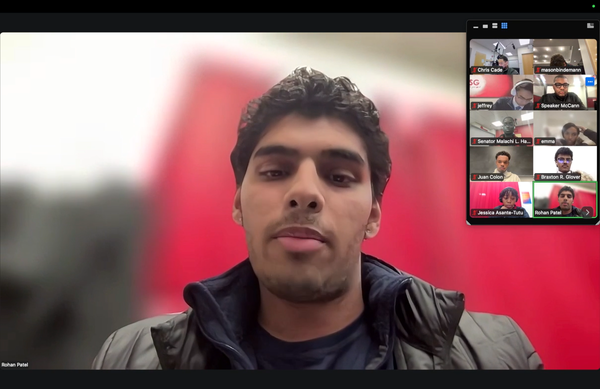
On November 5, I visited CFO Rohan Patel during office hours to ask about the gap between USG’s stated 7% figure and what they actually spent. Over the course of the next few days, after some back-and-forth, he wasn’t able to explain the discrepancy.
On November 10, he finally suggested I reach out to the Council on Student Affairs. So I did. I emailed CSA Chair Kirsten Meyers on November 13. She never responded.
And when I asked Speaker McCann directly on November 16, after he publicly called my number incorrect, he declined to offer a correction. Instead, I got a statement about “focusing on the work that moves the 58th General Assembly forward.”
The Cost of Not Knowing
It might sound like a technical squabble, whether Student Government takes 7%, 10%, or 17% of the Student Activity Fee. But Speaker McCann’s insistence that I had the number wrong wasn’t about defending accuracy. It was a deflection.
I had just stated that Student Government receives more money than all 1,500 other student organizations on campus combined. Rather than address that claim, McCann jumped in to challenge the specific figure I had used and emphatically declared, “That’s incorrect, sir.”
When USG claims it gets “around 7%,” but actually spends 14.26% of the total SAF, that gap isn’t abstract. It’s the budgetary equivalent of funding for 1,000 other student organizations. And it could very well be the difference between an upstart org hosting its first event or folding before it truly starts.
If that level of spending is defensible, the people in charge should at least be able to say how much is being spent. But no one in leadership has. And when those entrusted with the budget either can’t or won’t account for the total, it’s rarely because the figures are too small to matter.
It’s because they aren’t supposed to be looked at too closely. Budgets made in the dark rarely serve those not holding the flashlight.