
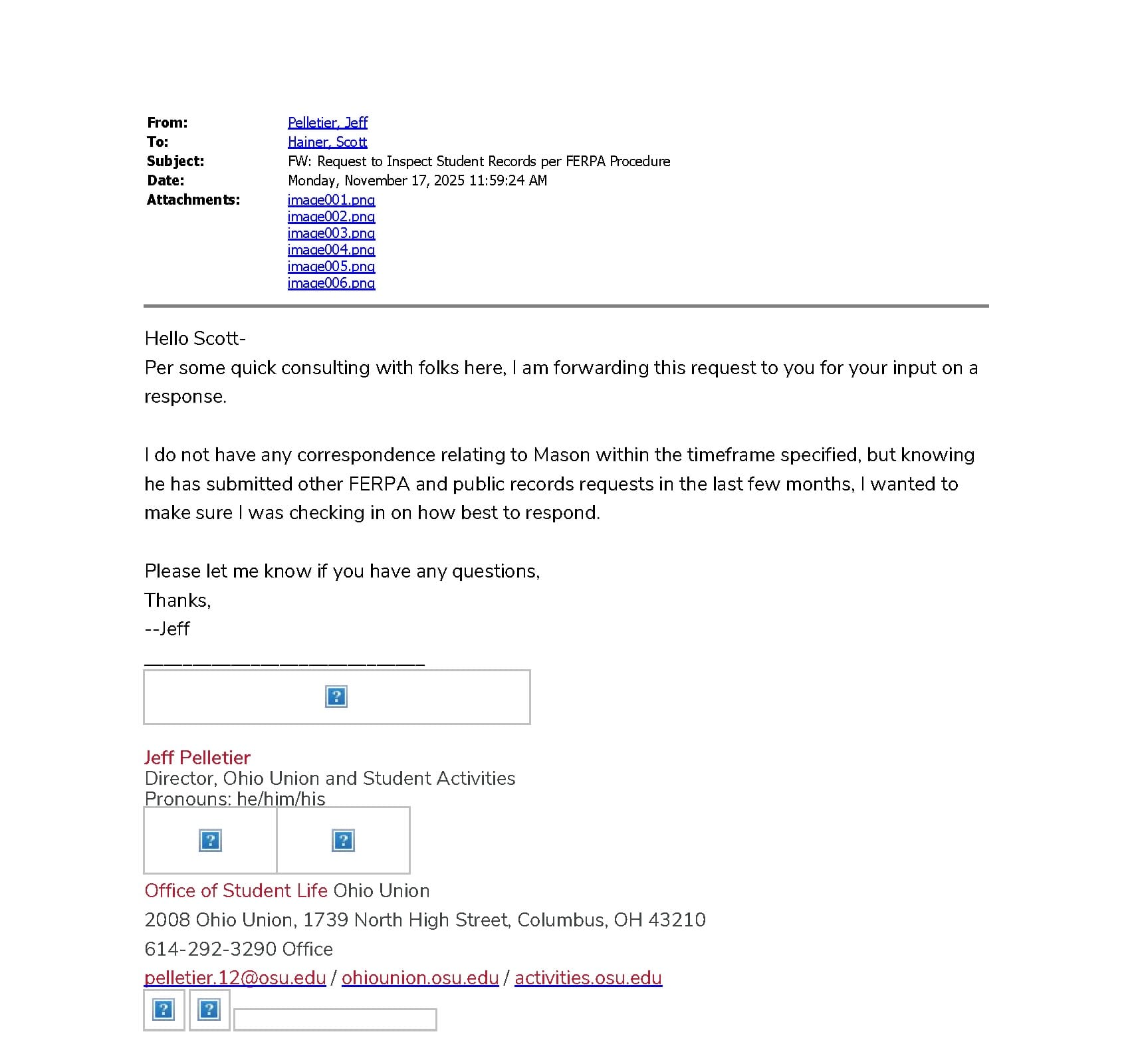
On November 17, 2025, Jeff Pelletier, Director of the Ohio Union and Student Activities, forwarded my FERPA request to Scott Hainer, the university's Director of Public Records and Compliance Reporting: "Knowing he has submitted other FERPA and public records requests in the last few months, I wanted to make sure I was checking in on how best to respond."
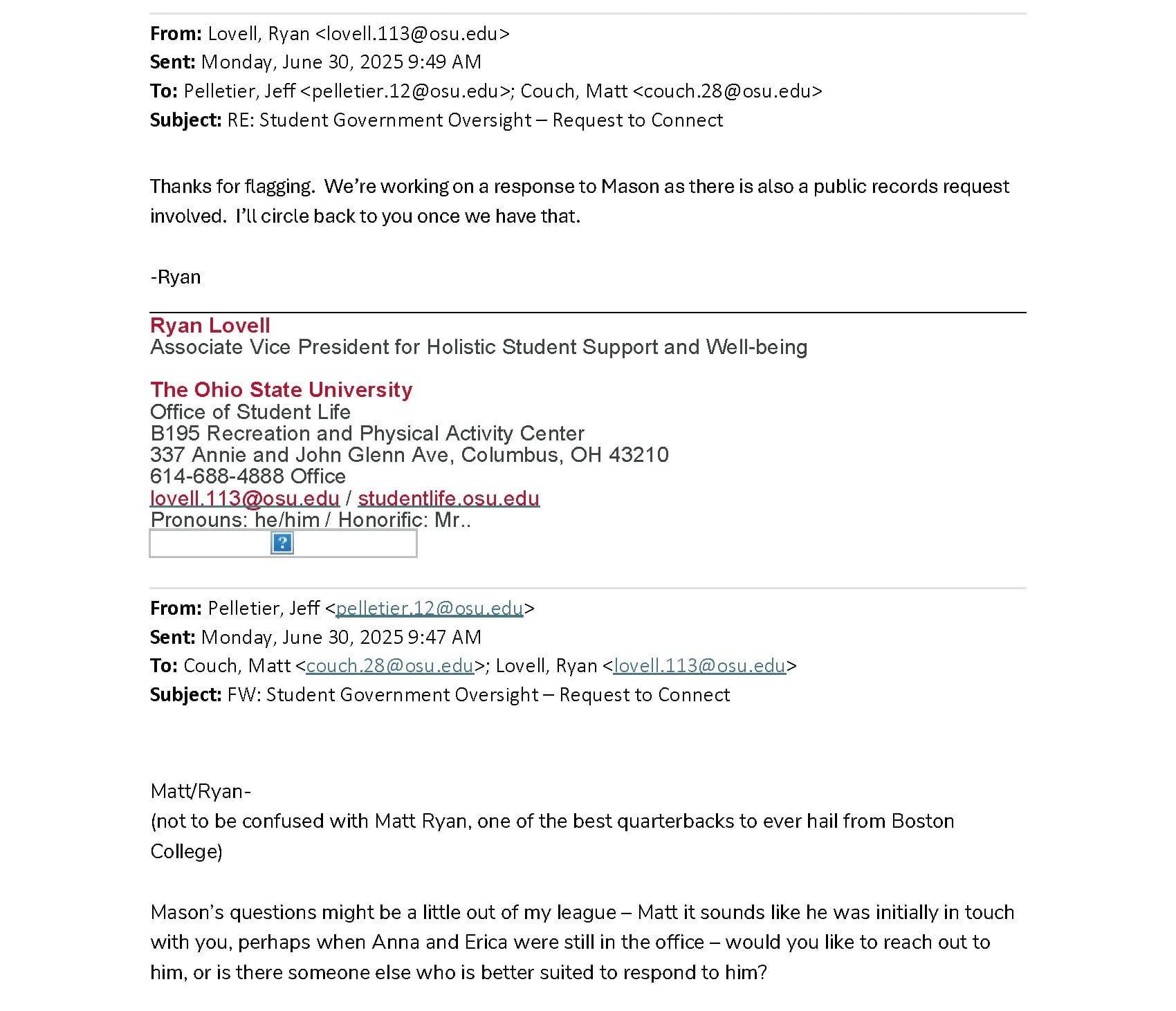
Four and a half months earlier, on June 30, Ryan Lovell, Associate Vice President for Holistic Student Support and Well-being and Dean of Students, had written to his colleagues about my separate journalistic inquiries: "We're working on a response to Mason as there is also a public records request involved."
Why would a student's exercise of their statutory rights under Ohio Revised Code § 149.43 be treated as relevant context for responding to entirely unrelated questions about how Student Life operates within Ohio State's Shared Governance structure?
I never got an answer to that question through the public records process. Instead, I had to weaponize the very law Ohio State used against me—FERPA—to break through and get it.
The Request
In late June 2025, I filed a public records request. I'd been publishing investigative pieces questioning whether Student Life had the authority to override USG's Judicial Panel and vacate an entire student government election.
I'd tipped the story to Emma Pettit at The Chronicle of Higher Education in late May. By mid-June, she'd confirmed she was working on it.
As I continued digging, USG insiders started sending me messages critical of my reporting methods. I was curious whether there was administrative coordination as well behind the scenes.
Given that the controversy centered on Student Life's decision to intervene in an election, evidence of administrators coordinating to manage or obstruct coverage of that intervention would be directly relevant.
The request was straightforward: communications mentioning my name or my journalism from May 1, 2025 onward.
On June 24, I submitted it. On June 25, Raashmi Rawal acknowledged it, promising a response "within a reasonable period of time."
By June 30, six days later, Student Life administrators were already tracking it. My public records request had become relevant context for handling my other inquiries.
The Pretextual Maze
It took a follow-up from me in early August, over a month after my initial request, to prompt any substantive response on the public records front. That's when Scott Hainer, Director of Public Records, finally entered the picture. On August 7, six weeks after I'd first submitted the request, Hainer issued his first denial.
Here's what's strange: if the request was so clearly inappropriate, why wasn't Hainer, the official responsible for making such determinations, looped in immediately? Why wait over a month for a legal assessment?
The delay suggests something else was happening first. Not a legal determination, a response strategy.
Over the next two months, Hainer's objections kept shifting. Each time I complied, a new barrier appeared.
First objection: The request was "overbroad, potentially voluminous," and lacked "sufficient specificity." So I narrowed it: a two-month window, specific keywords.
Second objection: No specific custodians. I proceeded to name 270 of them: faculty senators, senior administrators, Student Government officials.
Third objection: FERPA makes it all exempt. My journalism, published on Substack and in The Lantern, somehow constituted "student education records."
The pattern suggested pretextual rationalization rather than coherent legal reasoning.
By October, the university's position had solidified: everything I was seeking was protected by FERPA. Communications discussing my published articles by title. Administrative discussions of my reporting. All allegedly education records.
The reach was remarkable: I'd submitted a revised request that avoided mentioning my name at all, asking only for communications about specific article titles. Still allegedly protected under FERPA.
FERPA protects grades, transcripts, disciplinary files; not administrative discussions of a student's public journalism. But the claim worked as intended: it ended the conversation.
Hainer suggested I could access these records through FERPA's inspection process, by contacting individual unit custodians. When I asked for those contacts, which he'd explicitly offered to provide, I got silence.
For a month.
When I followed up repeatedly, the answer came: "You will need to identify and direct your FERPA request to the office from which you are seeking FERPA-protected records."
I couldn't request records without knowing which offices had them. I couldn't find out which offices had them without already knowing. The university, despite offering to help, would not.
From Shield to Sword
Frustrated, I decided to call their bluff. In November, I submitted formal FERPA inspection requests to Student Life and Academic Affairs. I completed the Student Information Release form.
On December 19, Ryan Lovell delivered the responsive records.
There they were. Lovell's June 30 message about coordinating a response because "there is also a public records request involved." Pelletier's November 17 consultation with legal specifically because I had filed "other FERPA and public records requests."
The irony practically writes itself. FERPA, the very statute the university used to block these records from public disclosure, became the only recourse I had to actually get them produced.
That recourse only existed because I'm a student. Professional journalists investigating the university face the same FERPA wall with no way around it. They can't request their own education records because they have none.
The Quiet Part Out Loud
But now that I had the emails in hand, I wanted to give the university a chance to explain. On December 19, I asked University Communications for comment. I quoted Lovell's and Pelletier's emails and asked whether it was standard practice for a student's public records activity to be noted when responding to unrelated correspondence.
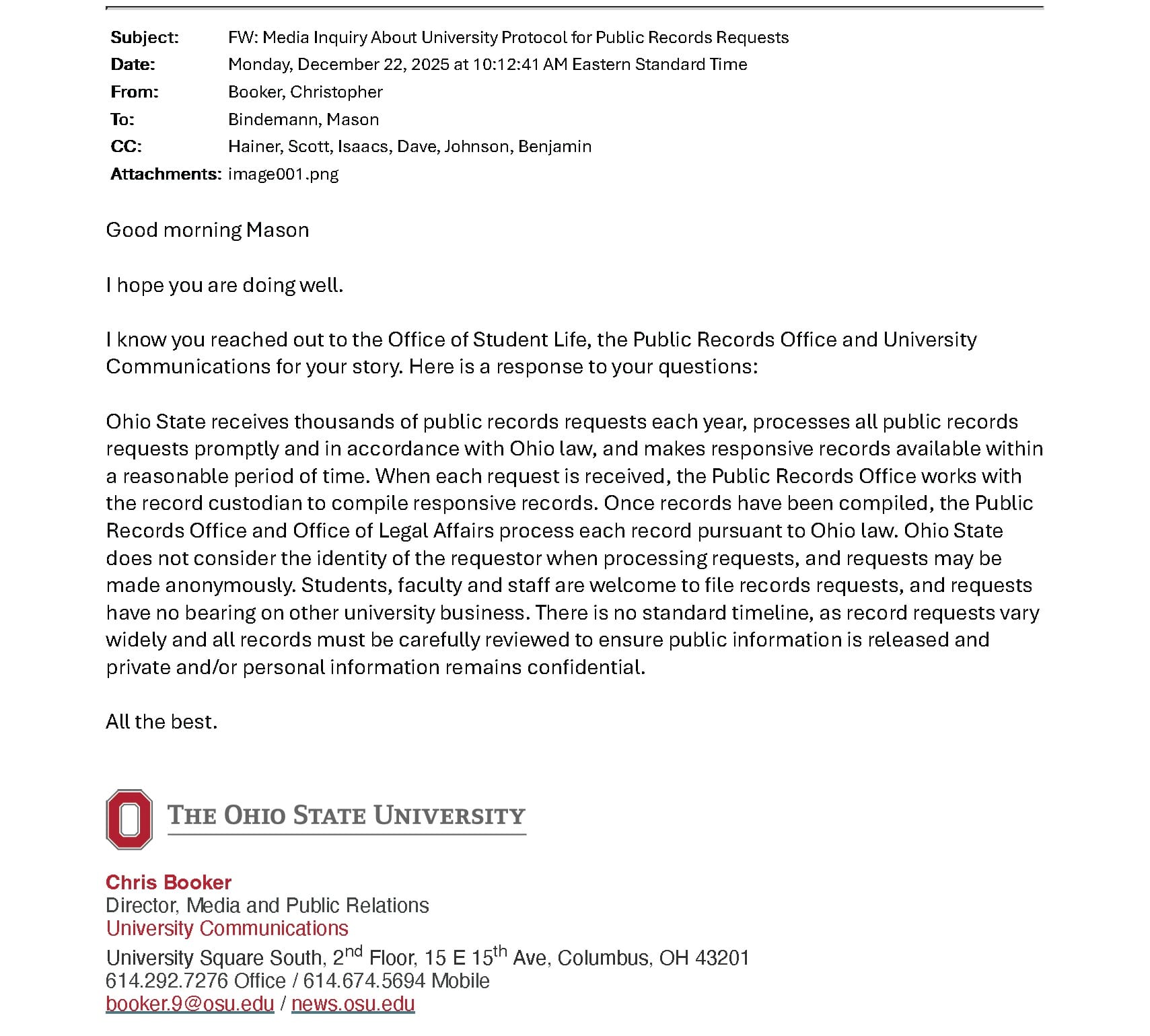
Chris Booker, Director of Media and Public Relations, responded definitively: "Ohio State does not consider the identity of the requestor when processing requests, and requests may be made anonymously... requests have no bearing on other university business."
I followed up, noting that I was asking about process: specifically, how the emails I'd provided aligned with his statement that requests "have no bearing on other university business." I received no response.
Pelletier, Lovell, and Hainer did not respond to separate requests for comment.
The anonymous part is worth lingering on. Booker seems to think it's reassuring, proof that the university treats all requesters equally. But read another way, it betrays something darker: that filing a public records request is understood, institutionally, as something that might warrant retaliation.
Why else emphasize that requests can be made anonymously, unless the university recognizes that making one under your own name carries risk?
The emails say what Booker won't: requests do have bearing on other university business. They matter enough to coordinate around, to consult legal about, to flag as relevant context in other matters.
Knowledge Will Forever Govern Ignorance
James Madison wrote in 1822: "Knowledge will forever govern ignorance: and a people who mean to be their own Governours, must arm themselves with the power which knowledge gives."
Ohio State talks constantly about student voice, student involvement, shared governance. Student Life's mission emphasizes "empowering student leadership."
But when a student tries to understand how power operates, when they exercise their statutory right to inspect public records, they become a problem to manage.
After five months, multiple revisions, and 270 named custodians, I still don't have the public records I requested. I still don't know the full extent of what administrators said about my journalism, at least, not through the process designed to provide that information.
Through FERPA, I obtained emails showing Student Life administrators treating my public records requests as relevant context for entirely separate inquiries. Not academic records. Administrative coordination about how to handle a student journalist.
FERPA shouldn't have protected these records. But it protected the university from having to produce them quickly, publicly, or without exhausting every available objection first. The law became a procedural maze; not because the records were sensitive, but because disclosure itself was inconvenient.
In the end, the university got what it wanted. These records didn't surface until over three months after Pettit's Chronicle piece published, long after they could inform any coverage. There was only one problem: Lovell and Pelletier gave the game away.


