
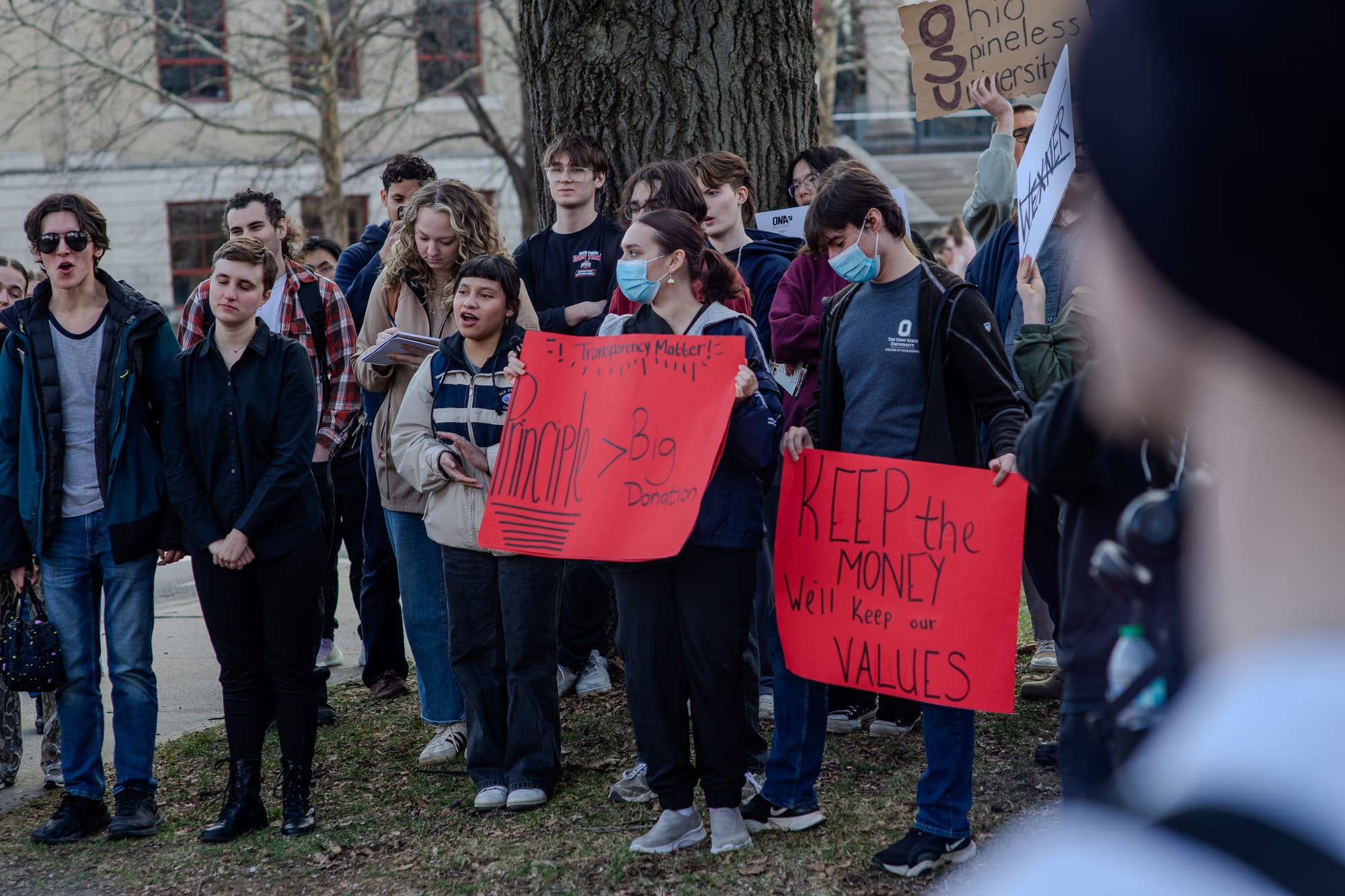
Shortly after 1:30 p.m. on Friday, a crowd of what appeared to be several hundred students, faculty, alumni, and survivors gathered at the Thompson Statue on the west end of the Oval before marching to its east end.
There, in the shadow of the Wexner Center for the Arts, the building whose name sits at the center of the dispute, survivors of the Dr. Richard Strauss sexual abuse scandal and other members of the campus community came forward to offer testimony at an open forum organized by the Central Ohio Revolutionary Socialists (CORS).
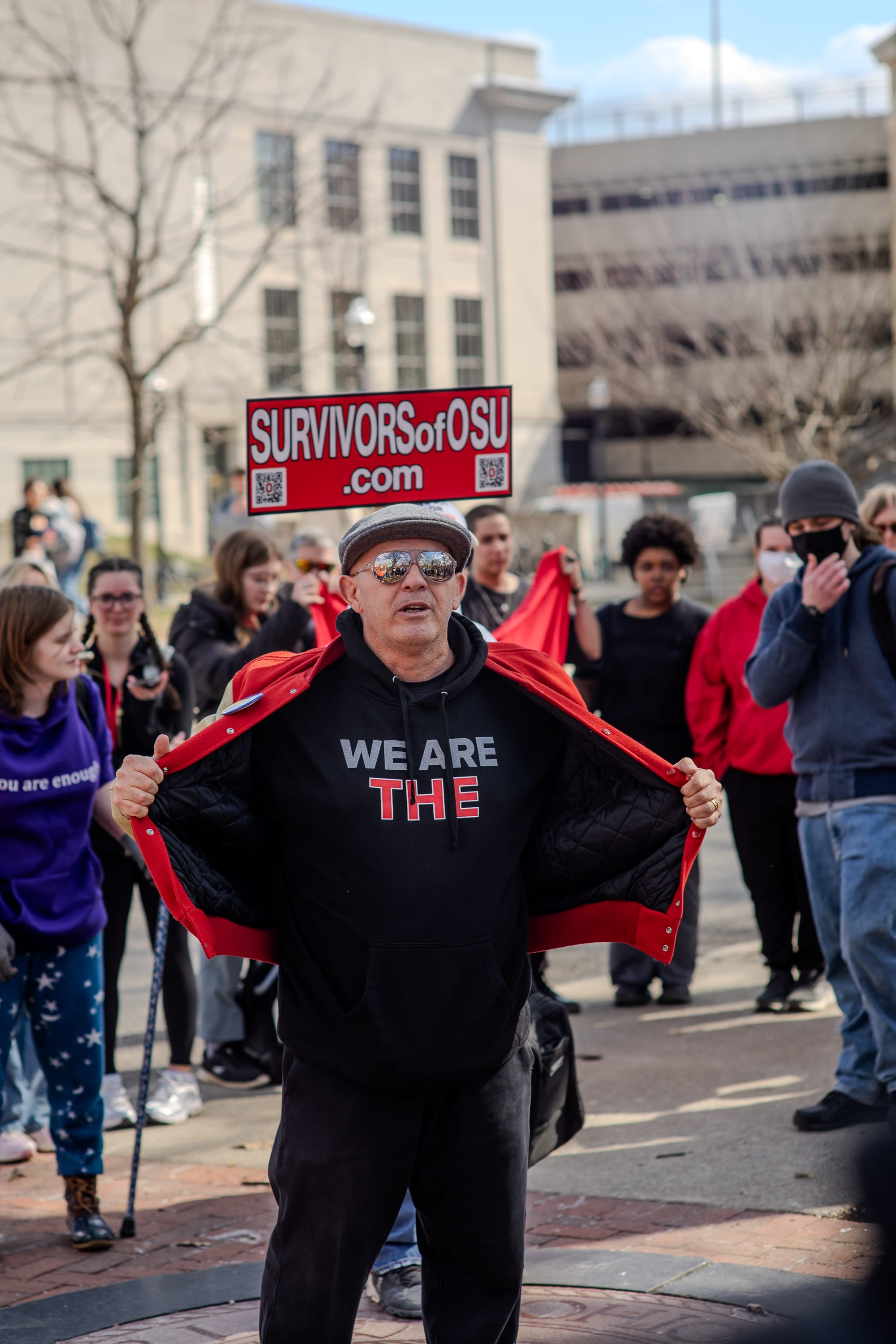
Michael DiSabato, who identified himself as the whistleblower of the Dr. Richard Strauss sexual abuse case, took the floor first. "In 2026, it will now be eight years that this university has traumatized former athletes," he said.
DiSabato invoked the legacy of legendary Buckeye coach Woody Hayes, whose theology, he argued, was one of service, discipline, and honor. "We are THE," he told the crowd, a phrase he returned to repeatedly, a deliberate reclamation of the trademark Ohio State has asserted.
"Les Wexner is not THE. He will never be THE." That legacy, DiSabato argued, has nothing to do with what the institution has spent years protecting. "It is certainly not about serial criminal pedophile sex traffickers," he said, repeating the phrase three times for the crowd.
He named Chairman John Zeiger, chairman of Ohio State's Board of Trustees, as what he called at minimum an enabler of these men. Zeiger's law firm has represented Wexner personally while Zeiger simultaneously chairs the board meant to govern the university, a dual role that critics argue makes genuine accountability impossible.
DiSabato also called out Vice Chair Elizabeth Kessler, noting she is the daughter of Jack Kessler, Wexner's longtime business partner in the New Albany Company. Her law firm, he noted, has represented Congressman Jim Jordan, DiSabato's former assistant coach and training partner at Ohio State, who DiSabato alleged "perjured himself over and over again" regarding his knowledge of Strauss's conduct in the locker room.
Two University Student Government (USG) senators spoke at the rally. Sen. Braxton R. Glover, a first-year in public affairs and political science, sponsored the USG resolution calling for Wexner's name to be removed from all campus buildings, branding, and official communications, a resolution the USG General Assembly passed on Wednesday, per The Lantern's reporting.
Sen. Christopher Cade, a second-year in public policy analysis and political science, pushed back against the administration's insistence on patience. "We will not be silent because of the transgressions that Wexner and Epstein and Strauss have committed against our students," he said. "They want us to go to class and not sit and not stand here. They want us to stay silent, but we will not."
The most striking testimony of the afternoon came from Kirk Dixon, 66, a former Ohio State baseball captain who came to Columbus from a blue-collar family on the south end of the city. Nobody in his family had ever gone to college. A baseball scholarship in 1978 changed that; the same year Dr. Richard Strauss arrived on campus as the team physician.
Dixon said he had not planned to speak. But standing before the crowd, he delivered the kind of confession that can only come from someone who has rehearsed it privately long before.
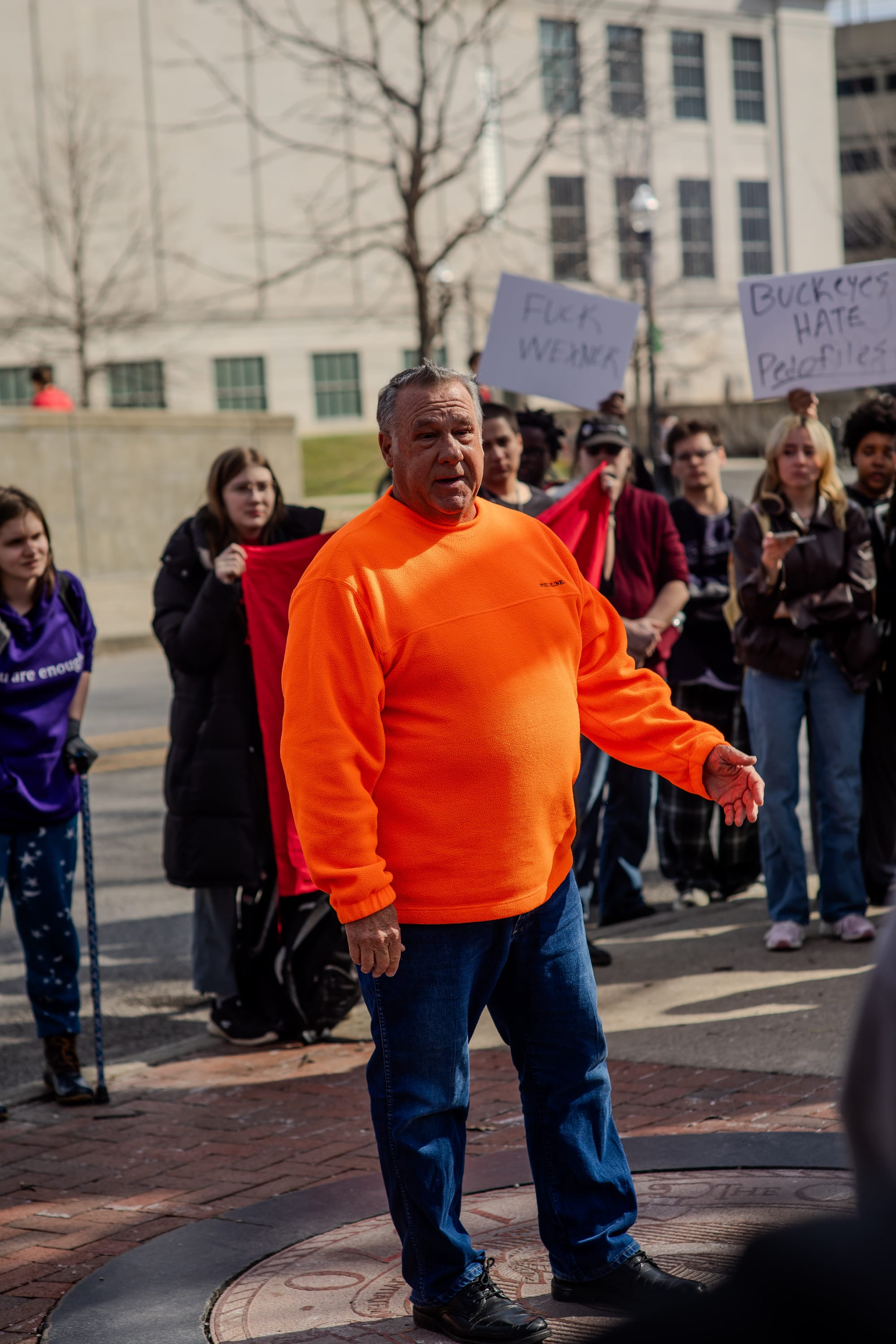
Strauss was Dixon's doctor for four years. Dixon described emerging from exam rooms where Strauss had conducted inappropriate examinations and looking into the eyes of teammates waiting behind him in line, hoping for some affirmation that he wasn't alone.
At the time, he never said a word. Being a scholarship athlete at Ohio State was, as he put it, "a huge home run" from where he came from, and he wasn't willing to jeopardize that.
Dixon went on to captain one of the most successful baseball teams in Ohio State history and earned a master's degree from the university. He built a career that spanned Reebok International, lululemon, and the NFL Player Development department.
But at forty, after making his first million, Dixon drove his car at 95 miles per hour into a parked vehicle on Interstate 270. He described it not as an act of despair but of exhaustion: he had accomplished everything he had set out to accomplish, and he still could not feel whole.
"I had carried so much shame from my four years being abused," he said. "Shame is different than guilt. Guilt, you feel bad you did something. Shame, you feel bad about who you are." He has not had a physical examination since leaving Strauss's care. He also spoke of now being sober for more than 500 days.
"Ohio State gave me a lot," Dixon said. "This is not a rain on Ohio State parade for me." But his message to the crowd was plain: external achievement cannot outrun internal damage. "If you don't fix what's broken inside, it will come back to bite you."
His ask of the Board of Trustees was simpler than everything that came before it. "All we're asking here at this gathering? Do your job."
As the rally wound down, Dixon returned to the microphone one last time. "I came here planning to learn," he said. "I've never done what I just did before. It's from the heart. But it's part of the healing."
Organizers announced a teach-in for March 6th and a rally at the Ohio State House on March 8th, International Working Women's Day, demanding that Governor DeWine, who appoints the Board of Trustees, take action on the Wexner naming rights question. Attendees were directed to SurvivorsofOSU.com. "We Are THE" T-shirts are available for purchase, with proceeds going to survivor support.


